Tuesday, June 28, 2016

What book next?


In my studies of contemplative photography, I have now read and worked through the exercises in Karr/Wood’s The Practice of Contemplative Photography, and McQuade/Hall's Looking and Seeing.  As background I have read True Perception, Trungpa Rinpoche’s talks on dharma art.

Another workbook from McQuade/Hall is set to be released in fall 2016, but that project has already been delayed and may be delayed again. 

I have found two more books in this tradition.   From the reviews online, it seems Julie DuBose’s Effortless Beauty is more a collection of reflections on her practice, rather than a programmatic teaching text. Michael Wood’s Opening the Good Eye appears to be much the same.  DuBose’s text looks more interesting for including a discussion of editing, something largely avoided by Karr/Wood and McQuade/Hall.

Anyone have any personal experience with either text?

I am presently engaged with Hoffman’s Photography as Meditation, a collection of reflections on the intersection of Zen and photography (and not a workbook).  Also on my bookshelf is Gross/Shapiro’s Tao of Photography, as well as a collection of Minor White essays.


#

Photographer: Mankichi Shinshi


Here's someone whose work reminds me of my own.  I found him through this article at FotoFirst.  His website is here and he is on most of the major photo-sharing sites:

Think Twice:  http://www.mankichi44.com/
Flickr: https://www.flickr.com/photos/mankichi44/ 

Book review: McQuade & Hall. (2015). Looking and Seeing: An Introduction to Nalanda Miksang Contemplative Photography (Way of Seeing Book 1)

McQuade & Hall. Looking and Seeing: An Introduction to Nalanda Miksang Contemplative Photography (Way of Seeing Book 1). Drala Publishing, 2015

The preface makes no bones about the authors' focus:  "...we are really talking about Enlightenment."

The purpose of Miksang is not just to make pictures, but to reorient vision in order to wake up to the world beyond things.  "The most direct way to spontaneous creativity [is] not in “breaking the rules,” [but] in making contact with the world before there are rules at all.”  This can be accomplished, the authors believe, with just a short shift of orientation, or Enlightenment by a few degrees.  They compare the mind to a ship, whose destination can be radically altered by a course change of just a few degrees.

The authors are students of Sakyong Trungpa Rinpoche, one of the first Tibetan refugees of the early exodus to settle and build a Buddhist community of westerners within the United States, and of his disciple, Sakyong Mipham Rinpoche.

This text promises to be the first of three outlining the practice of Miksang, a Tibetan word meaning "good eye."  While the authors feel Miksang is best taught, or transmitted, in face-to-face encounters, they realize as well the value of texts in being able to provide more detail than available in workshops, seminars, or lectures.

Monday, June 27, 2016

Looking and Seeing: Section Seven: Assignment: Dot in Space continued

I find I often don’t get far if I start synchronizing as soon as I walk out the door.

By synchronizing I refer to the process of calming the mind, of letting thought settle and inviting an awareness of presence - the ambient temperature, the wind, the smell and sound of the environment, the weight of my body, the placement of the limbs, the rhythm of the breath. I do this in preparation for and immediately prior to shooting in whatever environment I happen to find myself.

This weekend I was shooting my neighborhood and had the intention of visiting a far corner that I don’t often get to.  But following synchronization, I find my pace slows considerably - as I intend.  And then I never get any further than a couple of blocks from my starting point because there is so much interesting detail nearby.

My solution was to walk deliberately to that far corner without my camera to hand and do my synchronization there, rather than right outside the door.  I thought of my walk as driving to my destination and that turned out to be a workable solution.

Friday, June 24, 2016

A new hero in my pantheon of photographers: Harry Gruyaert

Gruyaert - Launderette 1988
Sometimes FB throws up something worthy.

Today it was this piece from the BJP with the headline:
“There is no story. It’s just a question of shapes and light”

On further investigation, I found:
“In Europe and especially France, there’s a humanistic tradition of people like Cartier-Bresson where the most important thing is the people, not so much the environment,” he says. “I admired it, but I was never linked to it. I was much more interested in all the elements:  the decor and the lighting and all the cars: the details were as important as humans. That’s a different attitude altogether.”

And later still:
“It’s purely intuition. There’s no concept. things attract me and it works both ways. I’m fascinated by the miracle where things come together in a way where things make sense to me, so there’s very little thinking.”

The occasion for this interview is publication of his first English-language monograph.  (BJP's FB update was to note his receipt of the 2016 PHotoEspaña Award.)  Buy the book, or visit Magnum for a collection of over 100 images.

Another interview from 2015 contains this gem on his experience of learning:
When he was 18, Gruyaert took himself off to Brussels to enrol in a film and photography school. It was here that he began spending all his time in the cinema. “The school was terrible, and I was learning nothing. But in watching films I started to understand composition and movement… I went to galleries to look at paintings, I bought magazines and books, and gradually I discovered how to see.”

#

Thursday, June 23, 2016

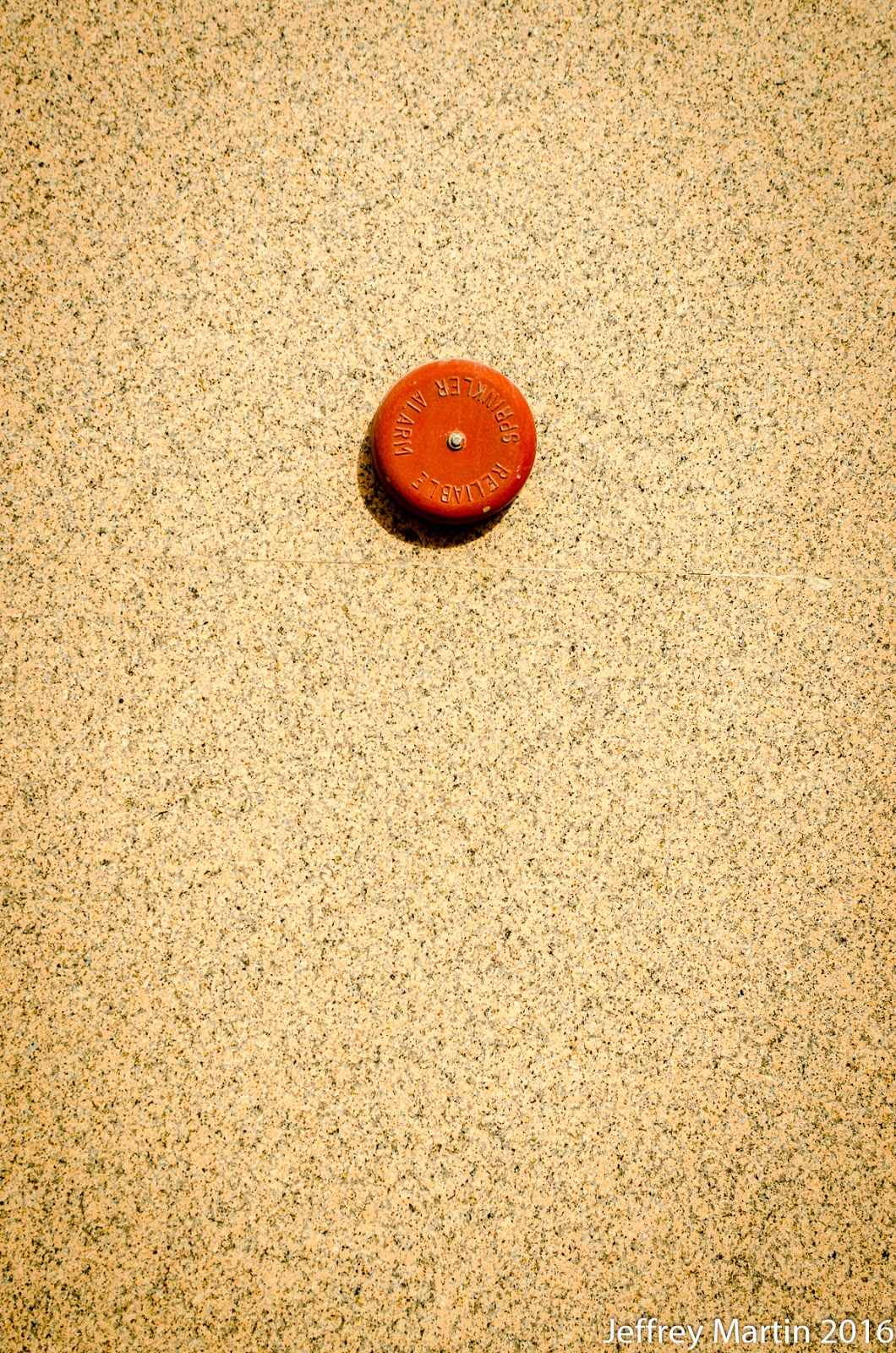
Looking and Seeing: Section Seven: Assignment: Dot in Space


Dot in space ... “is the key to the visual as the visual.”  The authors assert it encapsulates the experience of seeing:  to see a figure on a ground.  (As I’ve been arguing all along), seeing is possible because of contrast, because one thing is different from another thing. Perception, the authors argue, is an expression of a foreground figure on a background, or dot-in-space.  In fact, “all the photographs we have taken so far are dot in space.”

They then use a common optical illusion, which can be seen in one of two ways, to demonstrate how the perceiver creates perception.  They do this to make the point that perception and perceiver cannot be separated.  There is, in other words, no objective visual reality.

The assignment is to go out and shoot some dots-in-space. The chapter then proceeds to a discussion of Dot-in-Space as a Level Two practice, which the authors describe as “the world of sense and sensibility, the world of ordinary magic and everyday beauty.”

The biggest difference from Level 1 is a refinement of vision, a pulling back in which the abstract becomes concrete. (This appears to be contrary to conventional photographic practice, which begins with shooting things before learning to see them as symbols.)  There is direct engagement with things, rather than “a distanced documentation and representation.”  In Level 2, “the dot is no longer a formal perceptual value.”

The assignment is extended to work at Level 2 and seeing things as manifesting things. Unfortunately, it is not suggested how one might engage this kind of vision, but the authors claim that in reviewing photographs one should be able to distinguish between L1 and L2 images.  I’d like to see some side-by-side comparisons.

I will be shooting Dot in Space starting this weekend, but until then I have posted some recent images that seem to fit the bill.

#

Saturday, June 18, 2016

Book review: Trungpa, C., Lief, J. and Trungpa, C. (2008). True perception: the path of dharma art.

Trungpa, C., Lief, J. and Trungpa, C. (2008). True perception:  the path of dharma art. Boston: Shambhala.

This book constitutes the philosophical foundation of Miksang, sometimes known as Contemplative Photography, as taught by Trungpa Rinpoche, a Tibetan Buddhist spiritual leader and one of the first lamas to teach westerners in English vernacular.  His community proved to be long-lived and is known today principally as the center of a large Buddhist publishing concern, Shambala, and for a 4-year college, Naropa, the only accredited Buddhist institution of higher learning in the the United States.

This volume is not a treatise, but rather a collection of short texts, mostly transcribed talks on practice and aesthetics.  The book is comprised of 28 chapters, most only a few pages long.

The editor’s introduction summarizes Trungpa’s life, motivation, and goals, providing context for the texts that follow.  In essence, Trungpa was using a somewhat secularized version of Buddhist principles and practices to build an intentional community through which might emerge an enlightened society.  He was concerned with more than meditation or even art, but with all aspects of social engagement and management.