Showing posts with label Dot in Space. Show all posts

Monday, June 27, 2016

Looking and Seeing: Section Seven: Assignment: Dot in Space continued

I find I often don’t get far if I start synchronizing as soon as I walk out the door.

By synchronizing I refer to the process of calming the mind, of letting thought settle and inviting an awareness of presence - the ambient temperature, the wind, the smell and sound of the environment, the weight of my body, the placement of the limbs, the rhythm of the breath. I do this in preparation for and immediately prior to shooting in whatever environment I happen to find myself.

This weekend I was shooting my neighborhood and had the intention of visiting a far corner that I don’t often get to.  But following synchronization, I find my pace slows considerably - as I intend.  And then I never get any further than a couple of blocks from my starting point because there is so much interesting detail nearby.

My solution was to walk deliberately to that far corner without my camera to hand and do my synchronization there, rather than right outside the door.  I thought of my walk as driving to my destination and that turned out to be a workable solution.

Thursday, June 23, 2016

Looking and Seeing: Section Seven: Assignment: Dot in Space


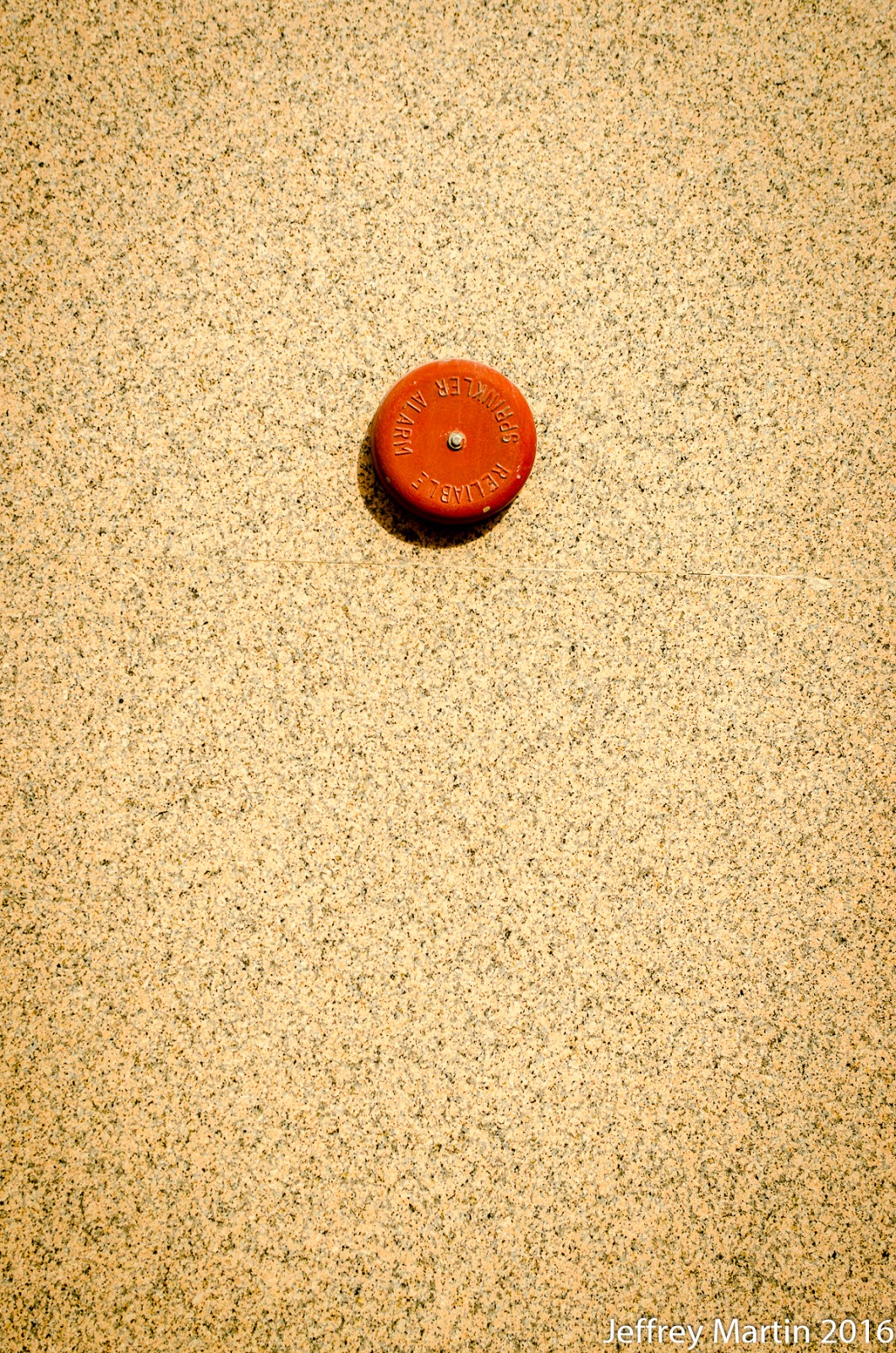
Dot in space ... “is the key to the visual as the visual.”  The authors assert it encapsulates the experience of seeing:  to see a figure on a ground.  (As I’ve been arguing all along), seeing is possible because of contrast, because one thing is different from another thing. Perception, the authors argue, is an expression of a foreground figure on a background, or dot-in-space.  In fact, “all the photographs we have taken so far are dot in space.”

They then use a common optical illusion, which can be seen in one of two ways, to demonstrate how the perceiver creates perception.  They do this to make the point that perception and perceiver cannot be separated.  There is, in other words, no objective visual reality.

The assignment is to go out and shoot some dots-in-space. The chapter then proceeds to a discussion of Dot-in-Space as a Level Two practice, which the authors describe as “the world of sense and sensibility, the world of ordinary magic and everyday beauty.”

The biggest difference from Level 1 is a refinement of vision, a pulling back in which the abstract becomes concrete. (This appears to be contrary to conventional photographic practice, which begins with shooting things before learning to see them as symbols.)  There is direct engagement with things, rather than “a distanced documentation and representation.”  In Level 2, “the dot is no longer a formal perceptual value.”

The assignment is extended to work at Level 2 and seeing things as manifesting things. Unfortunately, it is not suggested how one might engage this kind of vision, but the authors claim that in reviewing photographs one should be able to distinguish between L1 and L2 images.  I’d like to see some side-by-side comparisons.

I will be shooting Dot in Space starting this weekend, but until then I have posted some recent images that seem to fit the bill.

#