Saturday, January 16, 2016

Dubai Street Photography: Jalal Abuthina’s unseen side of Dubai

Jalal Abuthina’s unseen side of Dubai - in pictures

Jalal Abuthina’s unseen side of Dubai - in pictures
January 13, 2016

Jalal Abuthina has spent more than a decade taking photographs of Dubai’s older neighbourhoods. He has compiled them into three books. The Best of Dubai Shop Names, a collection of misunderstood and mistranslated shop signs. Dubai: Behind the Scenes takes the reader on a journey through the neighbourhoods of Deira, across Dubai Creek and into Bur Dubai. Memories of Satwa is a portrait of the ramshackle, low-rise neighbourhood.

Images
http://www.thenational.ae/arts-life/the-review/jalal-abuthinas-unseen-side-of-dubai---in-pictures

Article
http://www.thenational.ae/arts-life/the-review/dubai-uncovered-how-one-photographer-has-captured-the-other-side-of-the-city#full

Books are available from Gulf Photo Plus:  http://gulfphotoplus.com/search?q=jala

#

Contemplative Photography: Color 2

Apart from mom’s holiday, I haven’t done any shooting since the first CP color shoot about a month ago.  I was sick this past week so didn’t do a thing but work and sleep. This weekend I finally had some energy and went for a haircut and then walked around Satwa for a bit trying to shoot color.  What I noticed most is how out of practice I felt.  There were a couple of good opportunities for portraits, but I just didn’t have the energy to interact with strangers.  Again I note that shooting color apart from shape or contrast is difficult and rather uninteresting.  


#

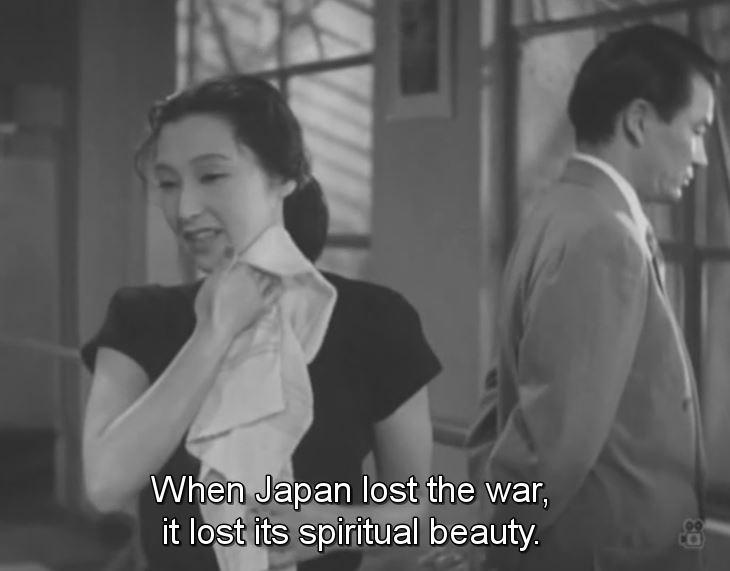
Film: Maihime, Naruse dir, 1951


Perhaps the most "literate" film I've yet seen by Naruse.  I'm sure the book (based on the novel by future Nobel Prize-winner Yasunari Kawabata) must be better.  His follow-up film (Meshi) explores some of the same themes and uses some of the same actors, at least one in an identical role (the male love interest waiting patiently for the female lead).

This line came from out of the blue, wasn't developed further,and doesn't much connect with anything in Naruse's previous work.

#

Friday, January 15, 2016

Hello

Eliphalet M Brown Jr, the first to make photographs in Japan

Eliphalet Brown's portrait of Namura Gohachiro 1854


Brown was the official photographer to Perry's 1853 expedition and made his first images in the contested territory of Okinawa, about which there is a frequently reproduced lithograph (below).  Of the possibly hundreds of images taken, according to Bennett (2006), only 16 have been positively identified.

A collection of lithographs made from Brown's images can be viewed here.

Bennett, T. (2006). Photography in Japan, 1853-1912. Tokyo: Tuttle.


Brown at work, center, in Okinawa, ca 1853

#

Book Review: Westerbeck, Colin, and Joel Meyerowitz. Bystander: A History of Street Photography. New York: Bulfinch, 2001. Print.

The first few chapters were of interest, but about halfway through I grew disappointed with the Great Artists approach. Westerbeck provides little in the way of technological, psychological or sociological perspectives on the prerequisites for street photography.  Having covered mostly France in the book’s preceding chapters, Westerbeck introduces "foreign" practitioners in Chapter 10, though what exactly constitutes foreign in this context is not clear.  The English are included (in the person of Bill Brandt), the Mexican (in Manuel Alvarez Bravo) and the Japanese (in Kineo Kuwabata).  Westerbeck notes all three produced work that could be said to mimic or be derived from that of Cartier-Bresson and wonders to what to degree they may have been consciously exploiting CB’s techniques or style.  Further still, he wonders if the nature of the medium and the city coalesce in the production of a particular kind of imagery.  This is precisely the kind of question that begs to be explored, but is largely ignored. 

Video: What makes a photographer when everyone is taking pictures?

Ken Van Sickle says:  
If you were there when the Hindenburg caught on fire, and you took a picture of it, that’s a great photograph. But you’re not a great photographer, because you can’t repeat that in everyday things.  
What a great photographer does is, they are consistently able to make something in a style that’s personal to themselves. My pictures don’t depend on extreme sharpness. They depend on the composition and on the subject and on the way I see it.

http://www.pbs.org/newshour/bb/what-makes-a-photographer-when-everyone-is-taking-pictures/#

"On the way I see it" seems to allow for anyone to produce anything and call him or herself a photographer. 

"Just the way I see it!"

#